On the 20th of February, 2026 (13:15: 15:00, CET), our very own Marwa Amri will have her final seminar (slutseminarium) in her PhD studies in Educational Sciences at Mälardalen University. Marwa has conducted her PhD studies within MIND Research group and has published three research articles on project work in English language classrooms. Her first study, published in the Modern Language Journal, looks into student-group work in a project at an upper-secondary school in Sweden. Her second and third studies, published in the Cambridge Journal of Education and Linguistics and Education, focus on between-desk interactions during project work in final year upper-secondary classrooms.
The (preliminary) title of Marwa’s PhD dissertation is “Doing project work in the English language classroom: The interactional accomplishment of project tasks, between-desk encounters and post-presentation discussions“.
The discussant for the seminar is Prof Erica Sandlund (Karlstad University). The internal examiner is Prof Nina Klang (Mälardalen University). The seminar will take place in Västerås (Ypsilon, U2-020).
The 4th MIND (Mälardalen INteraction and Didactics Research Group) mini-symposium will take place at Mälardalen University, Västerås, on the 20th of November, 2025. The theme of our symposium this year is “Beyond the binary of progressive vs. formal: interactional research on learning and teaching on the way to hybrid intelligence”. Teppo Jakonen (University of Turku) will be joining us in person – the title of his talk is “Learning by doing? The interplay of progressive and formal education in scripted VR-based medical simulation training”. In addition to our MIND researchers at Mälardalen University, we will welcome researchers like Nigel Musk, Silvia Kunitz, and Amanda Hoskins from Linköping University.
We will have research presentations, discussions, and events to facilitate collaborations. We will revisit the progressive vs. formal debate in education with a focus on interactional research. More updates will be sent out in late October.
We are happy to announce our data sessions for the current academic semester. The sessions are in hybrid mode and can be attended online or in person.
Our programme includes researchers based in Japan, Finland, the UK, Sweden and Türkiye. The topics and contexts include second language classrooms for young learners in Japan, an immersive virtual reality nursing simulation in L2 Finnish, and language classrooms in Sweden and Türkiye.
Please get in touch with Marwa Amri (marwa.amri@mdu.se) or Merve Bozbıyık (merve.bozbiyik@mdu.se) to receive the links and to register for our mailing list. We look forward to seeing you in Västerås or online.
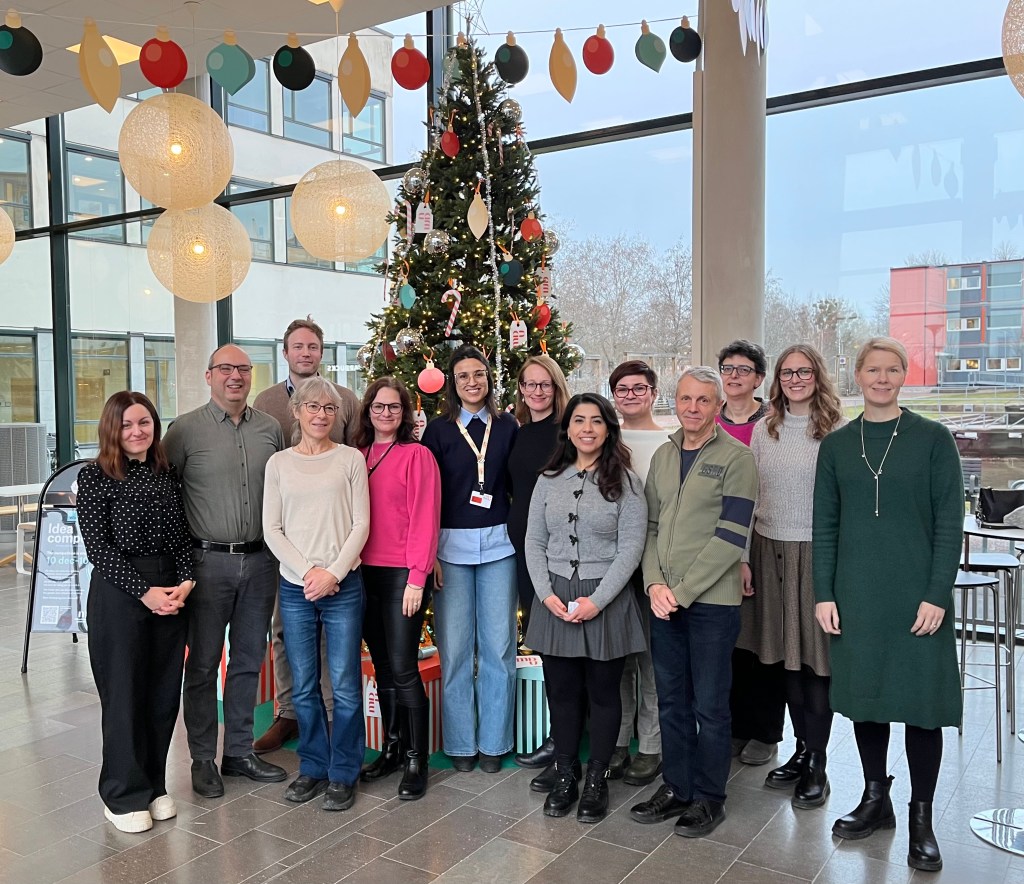
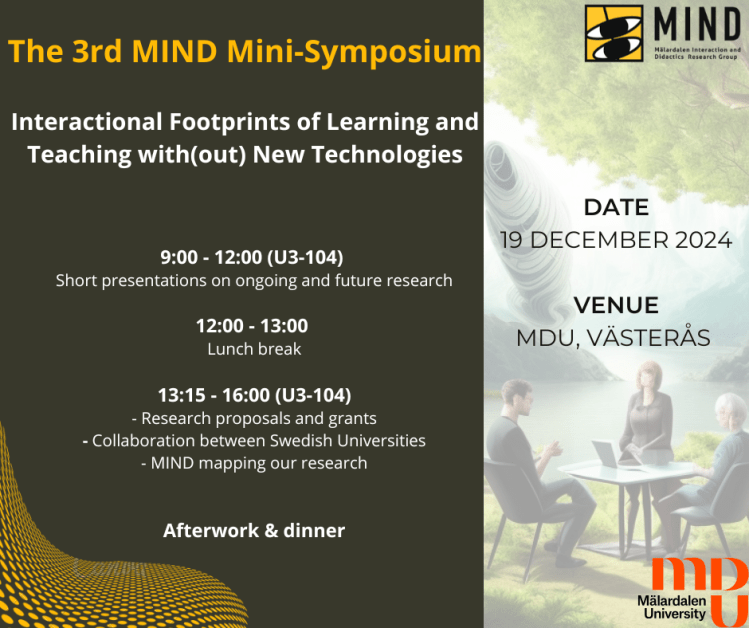
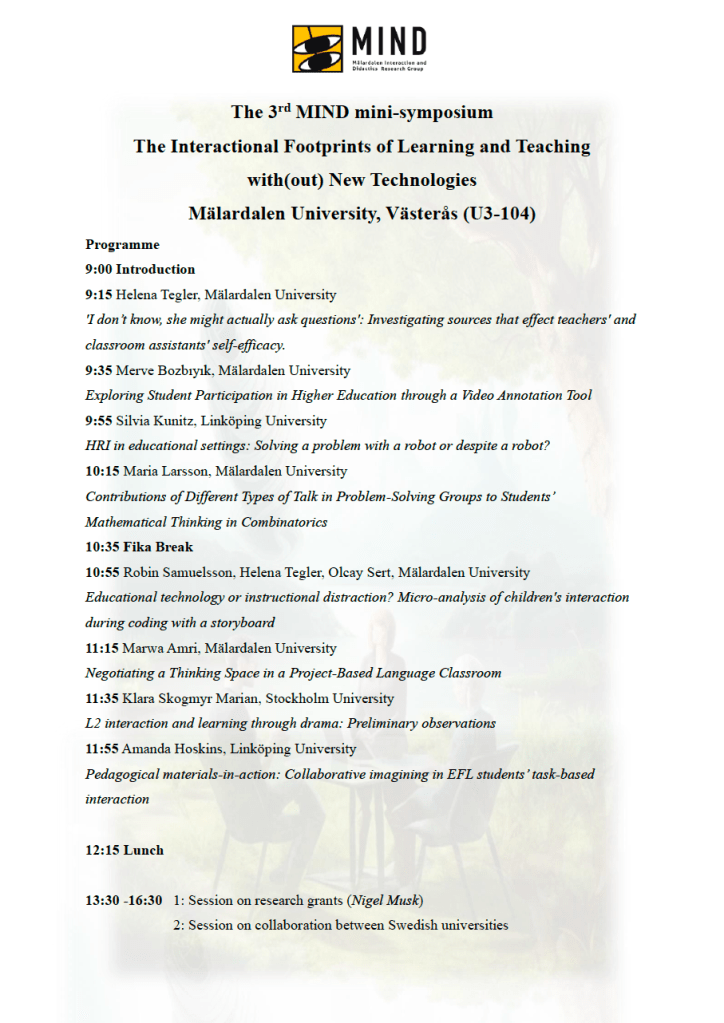
Pedagog Mälardalen has published a very good recap (på svenska) of the 3rd MIND (Mälardalen INteraction and Didactics) mini-symposium held at Mälardalen University. We engaged in discussions about research that is at the intersection of interaction and education, as well as research grants & collaboration between our research groups. We had a fantastic line up of presenters from Mälardalen University, Linköping University, and Stockholm University, who presented research on human-robot interaction in educational settings, CARM and teachers’ self-efficacy, student participation and well-being, children’s interactions during coding with a storyboard, project-based language teaching, interaction and learning through drama, and task-based interactions. Stay tuned for our research events in 2025!
We are happy to announce the list of data sessions to be organised by Mälardalen INteraction & Didactics (MIND) Research Group (in collaboration with MARG Research group at Newcastle University) during Autumn 2024! Our data sessions take place in hybrid mode. Please send an email to Merve Bozbıyık (merve.bozbiyik [at] mdu.se) and Marwa Amri (marwa.amri [at] mdu.se) if you want to attend sessions, receive updates from us, and present data in one of our future sessions.
Olcay Sert
On behalf of Mälardalen INteraction and Didactics (MIND) Research Group
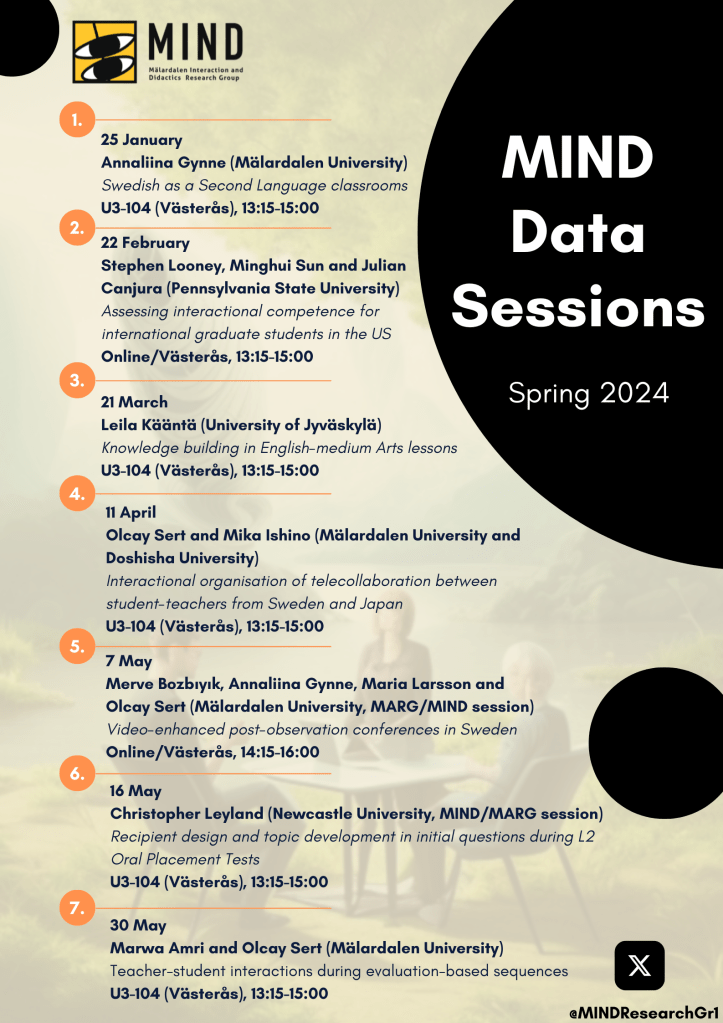
We are happy to announce our line up of data sessions for Spring 2024! ın addition to our own researchers at Mälardalen University, we will host data sessions led by researchers at Penn State University (US), University of Jyväskylä (Finland), Doshisha University (Japan), and Newcastle University (UK). We are glad that Christopher Leyland (Newcastle) and Leila Kääntä (Jyväskylä) will join us in person in Västerås.
This semester also marks the beginning of a collaboration between MARG (Multimodal Analysis Research Group, Newcastle University) and MIND (Mälardalen INteraction & Didactics Research Group), as two groups join their forces in organising data sessions. This is part of a growing collaboration between Newcastle University and Mälardalen University.
Our data sessions take place in hybrid mode. Please send an email to Merve Bozbıyık (merve.bozbiyik [at] mdu.se) and Marwa Amri (marwa.amri [at] mdu.se) if you want to attend sessions, receive updates from us, and present data in one of our future sessions.
At the crossroads of collaboration, interaction and development: A MIND map for research onteaching and learning
On the 14th of December, MIND (Mälardalen INteraction and Didactics) research group organised the 2nd MIND mini-symposium: “At the crossroads of collaboration, interaction and development – A MIND map for research on teaching and learning”. With MIND researchers from Mälardalen UniversityTurun yliopisto – University of TurkuMasaryk University and our guests from Stockholm University & Linköping University, we started the day with 7 presentations on #AI-assisted #teacher#education, #classroom interaction with #telepresence#robots, human-#robot interaction, oral #proficiency exams, #online teaching in #university classrooms #EMI, aided-communication in special education, and #drama-based teaching. MIND research day showcased the diversity of interests around which similar minded researchers and educators can come together and discuss, cooperate, and collaborate. After the presentations, we had three newly-tested collaborative activities: (1) Collaborative MIND-mapping / (Re)imagining MIND (ReMINDing), (2) Research Speed Dating – Pairing and teaming for future research, and (3) Imagining and visualising future research proposals. We are building MIND together, co-imagining our future with INTERACTION at the centre for research that matters and education for all.
We do not just believe, but also repeatedly demonstrate through our research that without a focus on the complex details of interaction one cannot truly understand the underlying dynamics of teaching, learning, and education.
Helena Tegler’s higher seminar (Högre seminariet i didaktik) takes place on the 8th of November at Mälardalen University in Västerås. The event can also be attended on Teams – so please get in touch with Helena or Olcay Sert if you want to receive the Teams link.
——————————————————————————
8 November:
Helena Tegler (MDU)
Teacher-fronted classroom interaction involving aided-speaking students with speech generating devices or communication boards
Our data session programme for Autumn 2023 is now out! All sessions will take place in Västerås (Thursdays, 13:15, Central European Time), with a possibility to attend online. Let us know if you are interested in joining in, and also present in one of our data sessions in Spring.
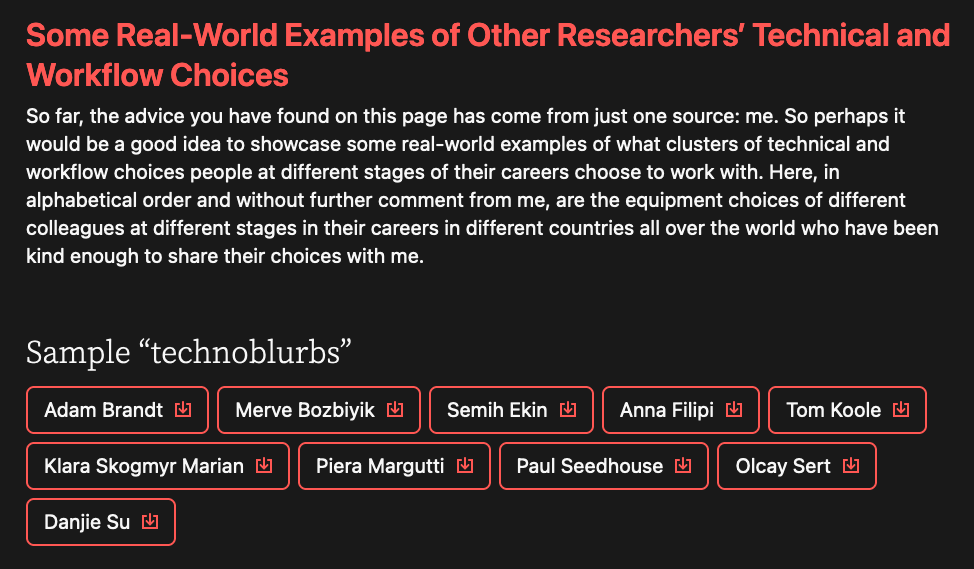
Numa Markee created a webpage that has very useful information for Conversation Analysis researchers who want to have an overview of software and hardware for recording, transcriptions, and other tasks: https://numamarkee.com/resources/
I wrote a piece about my technical and workflow choices and described how I use Transana, NVIVO, Antconc, VEO, GIMP, QuickTime, and Wondershare Filmore for my work. I hope this text would be useful for PhD students and early career researchers. I would like to thank again to the one and only Numa Markee for his support for novice researchers and never-ending energy to disseminate knowledge about CA.







 Mälardalen INteraction & Didactics (MIND) Research Group