How do teachers handle errors in mathematics classrooms?

How teachers handle errors of students in classrooms has been a topic of interest for researchers across disciplines. Mathematics is no exception to this. In this guest blog post, researchers Odd Tore Kaufmann (Østfold University College, Norway), Maria Larsson (MIND & M-TERM Research groups, Mälardalen University, Sweden) and Andreas Ryve (M-TERM Research group, Mälardalen University, Sweden) share their research findings on mathematics teachers’ error handling practices across different lesson phases, drawing on their analysis of lessons from several Swedish municipality schools. The full text of the research article is available open access, and can be downloaded using this link. Please scroll down for a short, accessible summary.

—————————————————————————————

Many studies have been conducted regarding teachers’ error-handling practices and how errors can be treated as opportunities for learning. Most of these studies have been done in the context of whole-class discussions. Therefore, we wanted to investigate teachers’ error-handling practices as they occur in different phases of mathematics lessons: introduction of the task, when students work alone, when students work in pairs, and finally, in whole-class discussions. We aimed to investigate if there are differences in error-handling practices across the lesson phases and what types of error-handling practices dominate the different lesson phases. We collected data from “Matematiklyftet (Boost for Mathematics),” a curriculum-based professional development program launched by the Swedish National Agency for Education. The study included 12 teachers and 51 lessons in grades 4-6 in Sweden. All lessons were video-taped. We categorized teachers’ error handling practices and found eight different types of error-handling. 

We found that in the introduction, the most common error handling practice was to ignore the error and give a direct correction (either by saying the correct answer or telling the student that s/he is wrong). We believe the reason for this strategy in the introduction of the lesson is that the teachers want to keep this phase short and avoid too many potentially confusing mathematical discussions.

When students work alone or in pairs, asking students to talk to each other and reflect is the most common error handling practice, in addition to correcting students’ errors by direct or embedded corrections. Embedded correction aims to lead the student towards the correct answer with one or more funnelling questions or comments. The set-up of error-handling practices during these phases is in resonance with the idea that teachers should not disturb students during their mathematical work, hence being somewhat invisible or non-intervening while students are working.

A larger variation of error-handling practices was found in whole-class discussions including discussion and teacher explanation. In a whole-class discussion, often held at the end of the lessons observed, the teacher uses the opportunity to bring up errors that s/he had noticed during individual/group work. In such situations, the teacher involves the students in discussing errors more than s/he does in other lesson phases.

What do these findings tell us?

The study revealed how teachers handle errors within and across lesson phases, and has implications for learning, teaching, and teacher education. We argue that involving students to discuss errors, rather than merely ignoring or correcting them, may enhance learning opportunities. They can give their students time and opportunities to discuss and resolve their errors with their peers in small groups and in whole-class settings. Teachers, however, need to develop awareness of differences between different lesson phases in order to achieve this. This requires that teachers reflect on their lessons to observe these interactional practices, and opportunities for such reflections should be a part of both initial teacher education and continuous professional development.

To read the full text of this research article, please follow this link.

Odd Tore Kaufmann  (Østfold University College, Norway)

Maria Larsson (MIND & M-TERM Research groups, Mälardalen University, Sweden)

Andreas Ryve (M-TERM Research group, Mälardalen University, Sweden)

MIND Data sessions, Autumn 2022

Please get in touch with Olcay Sert (olcay.sert[at]mdu.se) if you want to join in.

________________________________________________________

MIND Data Sessions – Autumn 2022

———————

13 October:

Olcay Sert, Marwa Amri, Annaliina Gynne (Mälardalen University)

Transforming situated language policies through data-led reflections on classroom interaction (CA/Ethnography data session)

U3-083, Västerås, 13:15-14:45

———————

3 November:

Teppo Jakonen (University of Turku), Olcay Sert (Mälardalen University)

Telepresence robots in language classrooms

Online, 13:00-14:30 (send an email to olcay.sert@mdu.se for the Zoom link)

———————

1 December:

Merve Bozbıyık (Universidad Autónoma de Madrid, Spain)

Online classroom interaction in an English Medium Instruction context

U3-104 (Västerås), 13:15-14:45

———————

15 December:

Marwa Amri (Mälardalen University)

Project work in upper-secondary English language classrooms in Sweden

U3-083, Västerås, 13:15-14:45


Some reflections on the ECER 2022 conference: from Mälardalen to Yerevan

Olcay Sert's avatarOlcay Sert

I am one of those who think that one needs to balance “big” and more focused “small” conferences during a year: you can dig in deep in more subject/methodology/field specific small conferences, and map the broader field in a big one. For me, the European Conference on Educational Research (ECER) 2022 in Yerevan was a big one: the whole field of education! Even language education conferences or big applied linguistics conferences (e.g. AAAL) are massive, but what was I doing in Yerevan? I will start from the beginning of the story.

On the 21st of December, 2021, we decided to have a conference abstract writing workshop under Elin Sundström Sjödin‘s leadership, organised by SOLD (Language and Literature) research environment. After a successful workshop and rounds of peer-feedback, all of those who submitted an abstract (1300 words!) got accepted: Christa Roux Sparreskog, Simon Sjölund, Elin Sundström Sjödin,

View original post 586 more words

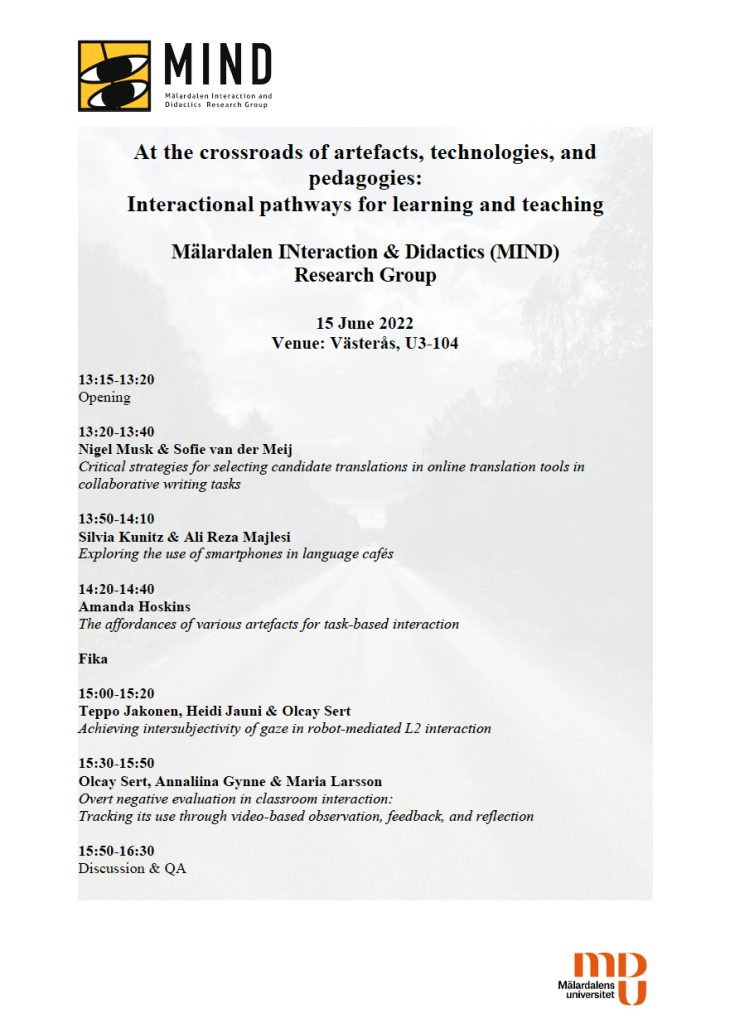
At the crossroads of artefacts, technologies, and pedagogies: Interactional pathways for learning and teaching

Mälardalen INteraction & Didactics (MIND) Research group is organizing a symposium on the 15th of June in Västerås. The theme of the symposium is “At the crossroads of artefacts, technologies, and pedagogies: Interactional pathways for learning and teaching”. Together with researchers from different universities in Sweden and Finland, we will discuss our ongoing research as well as future directions.
The symposium brings together projects that address the use of online translation tools, smartphones, telepresence robots, mobile observation tools, and other artefacts both in formal and informal learning environments, with a focus on micro-analysis of interaction.

Please send an email to olcay.sert[at]mdu.se by the 8th of June if you want to join us.

At the crossroads of artefacts, technologies, and pedagogies:
Interactional pathways for learning and teaching

Mälardalen INteraction & Didactics (MIND)
Research Group

15 June 2022
Venue: Västerås, U3-104
13:15-13:20
Opening

13:20-13:40
Nigel Musk & Sofie van der Meij

Critical strategies for selecting candidate translations in online translation tools in collaborative writing tasks

13:50-14:10
Silvia Kunitz & Ali Reza Majlesi

Exploring the use of smartphones in language cafés

14:20-14:40
Amanda Hoskins

The affordances of various artefacts for task-based interaction

Fika

15:00-15:20
Teppo Jakonen, Heidi Jauni & Olcay Sert

Achieving intersubjectivity of gaze in robot-mediated L2 interaction

15:30-15:50
Olcay Sert, Annaliina Gynne & Maria Larsson

Overt negative evaluation in classroom interaction:
Tracking its use through video-based observation, feedback, and reflection

15:50-16:30
Discussion & QA

Poster: At the crossroads of artefacts, technologies, and pedagogies:
Interactional pathways for learning and teaching

Data session with Teppo Jakonen (Finland): Telepresence robot mediated classroom interaction

3 June 2021, Online data session:

Teppo Jakonen (University of Jyväskylä, Finland)

Telepresence robot mediated classroom interaction

Zoom, 13:15-14:45 (CET)

Please get in touch with Marwa Amri at marwa.amri@mdh.se for the Zoom link and the password.

Online MIND data session: Rizwan-Ul Huq (Linköping University, Sweden)

27 May 2021, Online data session:

Rizwan-Ul Huq (Linköping University, Sweden)

Teacher-initiated classroom reproach in a Bangladeshi EMI lesson

Zoom, 13:15-14:45 (CET)

Please get in touch with Marwa Amri at marwa.amri@mdh.se for the Zoom link and the password.

Change of date: Data session on telepresence robot mediated classroom interaction

Teppo Jakonen’s online data session “Telepresence robot mediated classroom interaction” has been postponed to the 3rd of June, 13:15 (CET). See the updated list of data session below. Get in touch with us at olcay.sert@mdh.se or marwa.amri@mdh.se for information.

Online data session- Stephen Looney

Our next online data session will be led by Stephen Looney (The Pennsylvania State University). Steven will present data from a large body of video-recorded classrooms collected over the course of a semester in an Intensive English Program at a large US research university. Please see the event poster below for details on the date. Send an email to marwa.amri@mdh.se to register for the session.

Two data sessions at Mälardalen University, 24 January

MIND is organizing two data sessions on the 24th of January, Friday, with Søren Wind Eskildsen (University of Southern Denmark), Niina Lilja (Tampere University) and Silvia Kunitz (Stockholm University/Karlstad University). The sessions will take place at Mälardalen University (Västerås campus). Please see below for details on the venue and time.

Best wishes,

Olcay

On behalf of
Mälardalen INteraction & Didactics (MIND) Research Group


MIND data sessions, 24 January 2020
10:15 -12:00 – Swedish EFL Classroom Interaction
Olcay Sert and Marwa Amri

13:15 – 15:00 – Vocabulary in the classroom and in the wild
Silvia Kunitz, Niina Lilja, Søren Wind Eskildsen and Olcay Sert

Venue: Ypsilon, Västerås